

Labor Day 2026 falls on Monday, September 7. For a lot of households that is the last three- or four-day window before school, fall sports, and shorter evenings take over.
That is why search interest jumps every year in the last days of August: not because people want another listicle, but because they need a decision. Drive Thursday or Friday? Fly into Denver or Seattle? Is a national park still worth it if the lot fills at 8 a.m.?
Here is a practical read of what is happening this year — and how to use it.


First, the calendar that actually matters
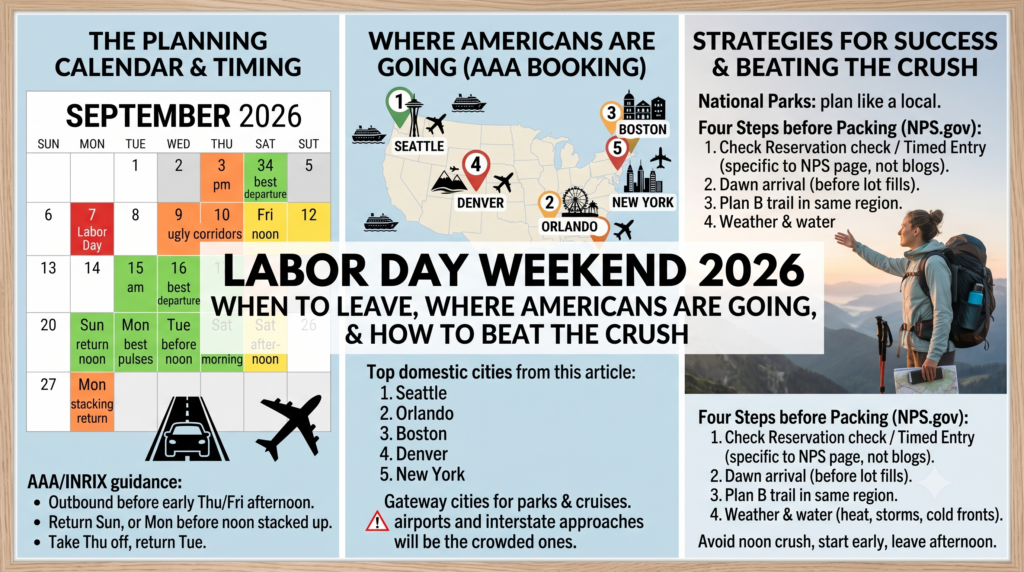
Treat the holiday as a Thursday-to-Tuesday problem, not a Monday problem.
- Thursday, Sept. 3 — early leavers mix with regular commuters. Afternoon is ugly on major corridors.
- Friday, Sept. 4 — peak departure day for both cars and airports.
- Saturday, Sept. 5 — destination traffic (beach towns, park entrance roads, downtown hotel check-in).
- Sunday, Sept. 6 — usually the quietest of the four days on the highways.
- Monday, Sept. 7 — return wave in the afternoon.
AAA and traffic-data firm INRIX have been consistent on the pattern: leave before early afternoon on Thursday and Friday if you are driving. Saturday morning is better than Saturday afternoon. Monday after lunch is when return trips stack up.
If you can take Thursday off and return Tuesday, you skip the two worst pulses.
Where the demand is actually going
AAA booking data for this Labor Day points to a familiar mix: big cities that double as flight hubs, plus gateways to parks and cruises.
Top domestic names this year
- Seattle
- Orlando
- Boston
- Denver
- New York
- Chicago
- Anaheim / Los Angeles
- Las Vegas
- Anchorage
- Atlanta
Seattle and Anchorage are not random. Cruise itineraries and Alaska / Pacific Northwest trips are pulling people north. Denver and Las Vegas keep showing up as fly-then-drive cities for Rocky Mountain, Arches, Zion, and Grand Canyon trips. Orlando is still the family default.
International bookings in the same reports lean Europe and Canada: Rome, Vancouver, London, Dublin, Paris.
Two cost notes from the same travel-industry wave of reports: domestic hotels and many domestic airfares are up versus last Labor Day, while some international fares are flatter or cheaper. That split is why you see more “stay in the U.S. but go farther west” searches alongside “is Europe cheaper this weekend?” searches.
Do not treat those city lists as a recommendation to go there. Treat them as a warning. Those airports and interstate approaches will be the crowded ones.
National parks: still the move, if you plan like a local
National Park Week wrapped on August 30, and Google already flagged the hiking spike behind it: searches for hiking safety tips and hiking for beginners jumped hard over the past month. Zion keeps showing up when people search hiking. Rocky Mountain shows up when people search beginner hikes. Acadia shows up when people search itineraries.
Labor Day does not turn a park into a secret. It turns a popular park into a parking problem.
If a park is on your list, decide these four things before you pack:
- Timed entry / reservation. Several high-demand parks require them in peak windows. Check the official NPS page for that park, not a blog from 2023.
- Dawn arrival. For Zion, Rocky Mountain, Acadia, and similar lots, “early” means before the lot is a circulating parking lot.
- A Plan B trail. Have a less famous trail in the same region so you are not sitting on a shoulder at 10 a.m. refreshing a shuttle app.
- Weather and water. Late summer in the West still means heat and afternoon storms. East Coast parks can swing from humidity to a cold front in one weekend.
A useful rule: if your only plan is “the most Instagrammed trail at noon on Saturday,” stay home. If your plan is “be on a secondary trail at 7 a.m. and leave the park before the afternoon surge,” the weekend still works.
Driving vs flying this year
Drive if the trip is under about six hours, you have a full car, or the destination is a park / beach town with bad rental-car availability.
Fly if you are crossing a time zone and can land Thursday. The expensive mistake is flying Friday afternoon into Seattle, Denver, or Orlando and then renting a car for a Saturday park attempt.
Road-trip timing that usually hurts the least:
- Outbound: Thursday morning, or Friday before noon
- Return: Sunday, or Monday before noon
Pack like the car is the backup plan: water, paper maps or offline maps, a charged power bank, and a real spare. Holiday weekends are when tow wait times get long.
A better question than “where is everyone going?”
Ask: what kind of weekend do we want, and which place still has inventory?
| If you want… | Better bet than the #1 list |
|---|---|
| Water without Orlando crowds | A second-tier Gulf or Atlantic town, midweek shoulder if you can stretch to Tuesday |
| Mountains without Denver airport chaos | A lesser-known range town 2–3 hours from a smaller airport |
| A city break | A walkable mid-size city not in AAA’s top five |
| One last hike | A state park or national forest next to the famous park, not the famous trail itself |
Rural and smaller coastal towns have been taking a larger share of holiday-rental searches this year. That is the quiet signal under the city rankings: a lot of people are trying to get out of the places everyone else is flying into.
What to do this Sunday (August 30) if you have not booked
You still have a week. Use it in this order:
- Pick the return time first. That decides whether Thursday departure is worth a vacation day.
- Check hotel + parking as one cost, not two. Downtown holiday parking can erase a “cheap” room.
- If a park is involved, screenshot the official reservation / shuttle rules tonight.
- Set two weather alerts: destination and the drive corridor.
- Tell the group the leaving time in writing. Holiday trips die in “we’ll see how we feel Friday morning.”
Labor Day is not a mystery. It is a short window, higher prices in the obvious places, and a lot of people making the same three reservations at the same hour.
Go a day earlier, aim one town over, or start the hike before the lot does. That is the whole strategy.